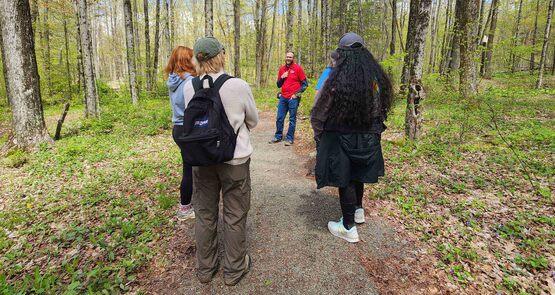
Hikers taking a quick break to talk and explore on the trail at Park Station, May 10, 2026.
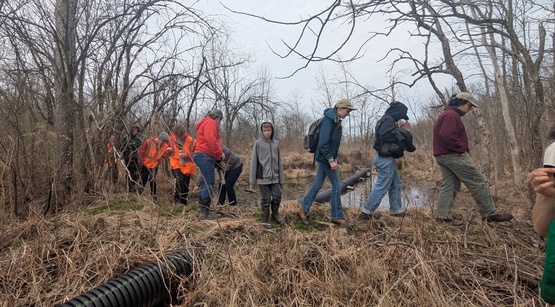
Natural resources outing to see the beaver baffles at Mark Twain State Park
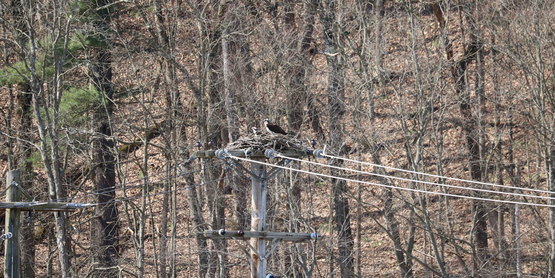
Ospreys on the nest at Mark Twain State Park
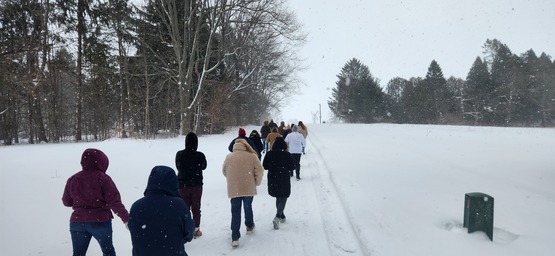
Winter hike at Shackelton Point for WHEP training
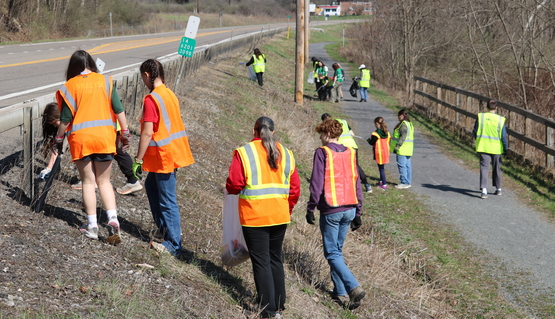
Catherine Valley Trail cleanup and birding hike
Hiking in Chemung County
Why Hike?
By dictionary definition, a hike, is “a long walk, especially in the country or wilderness.” While “hiking” does not always take place in a natural setting, the action is often associated with being in nature. In addition to the exercise hiking provides, studies have shown time in nature playing a positive role in health and wellbeing. So much so, that Cornell University Health clinicians and mental health providers “prescribe nature” to students. Research on Nature Rx doesn’t stop short of humans either – it has also been shown to improve the quality of life for lab mice!
Per the Nature Rx website, time spent in nature can:
- Improve your cognitive ability, specifically by boosting your ability to concentrate and increasing your attention span
- Positively benefit your mood and improve your sense of overall happiness
- Reduce feelings of and physiological responses to stress
- Increase your number of social connections and the quality of your social relationships
- Boost your physical health and well-being
Getting Started:
This page provides basic information on getting started finding, planning and navigating hikes in Chemung County and beyond. Whether you are completely new to the idea of hiking or are a seasoned veteran, the information in this resource guide will help you get on the trail.
Initial consideration for hikes should include appropriate footwear and clothing for the terrain and trail conditions you may encounter. In New York, you never really know what weather and conditions you may encounter day to day, so checking the weather at least 24 hours in advance of a hike is a good idea. Using the local news (WENY or WETM, The National Weather Service (NOAA), or your favorite weather app are all good options. Plan around the day’s conditions, choosing the appropriate footwear and layers to stay safe and comfortable.
Dressing in layers and choosing to wear wool or synthetic (nylon) materials over cotton is highly recommended. Wool and synthetic materials will dry faster and maintain thermal properties better when wet, helping keep you cool in hot conditions and warm in cool conditions. Additionally, too tight of a fit will diminish thermal capacity of socks and outerwear, so err on the side of too big.
Comfortable hiking shoes or boots that are advertised as waterproof is a good universal starting point for footwear – I recommend reading reviews and trying (with your hiking socks) as many pairs within your budget as possible before deciding. Another note - “waterproof” is not always true to advertisement - it is a good idea to test capabilities of your footwear at home before long hikes around water to keep your expectations realistic. Everything has a shelf life as well, so check gear regularly for form, fit, and function!
Always do a little research on the area you are planning to visit and find a physical or digital map of the area and/or use GPS based mapping/trail apps. Planning a route and doing research ahead of time allows you to set, have, and share realistic goals and expectations before spending time on the trail. Knowing where you are going and letting folks know your plan should be at the top of your list for safe and effective outdoor recreation. Sharing information (like where you are going and how long you are planning to be gone) with a friend or relative and having confirmation from them should be done before any adventure.
For navigation and planning, I have been using the OnX platform (paid subscription) for close to 10 years and it has worked incredibly well for me, but there are many other free/paid apps and resources available including Garmin, Google (Earth/Maps), Strava, All Trails, Gaia GPS, CalTopo, and others.
Planning your hike in a way that works for you is important, whether you are planning to hike one mile or one hundred miles. The NYS DEC has some excellent advice and resources for planning hikes - Hike Smart NY. Additionally, here is a great checklist and guide from Backcountry to help you through the planning process - Every Essential Hiking Item.
Last, but not least, practice other "leave no trace" principles to help ensure safe and responsible use of our natural resources in New York and Nationwide. - 7 Principles - Leave No Trace
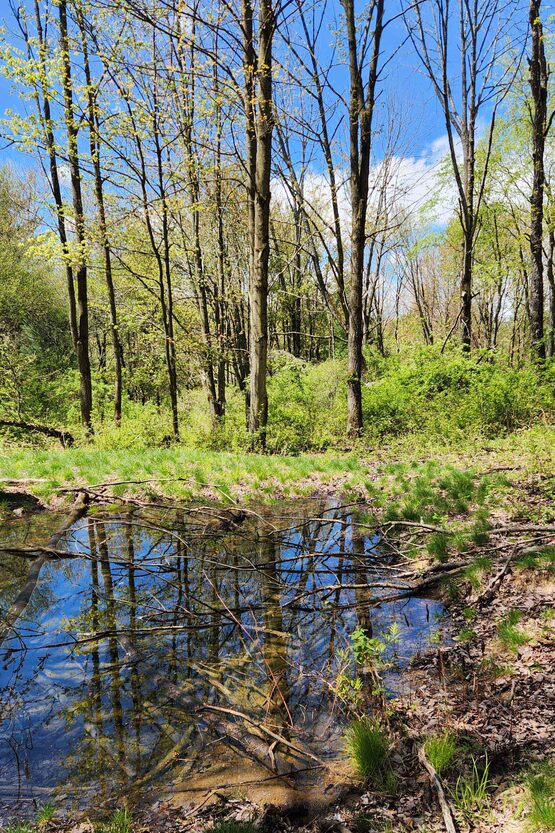
Ephemeral pools at Park Station provide habitat for breeding amphibians and other wildlife inhabiting the area. (Photo by: Todd Martin)
References and Resources:
Cornell Health. (2026 April). Nature Rx. Cornell University. https://health.cornell.edu/initiatives/campus-initiatives/nature-rx
Cornell Integrated Pest Management. (2026, April). Ticks. Cornell College of Agriculture and Life Sciences. https://cals.cornell.edu/integrated-pest-management/outreach-education/whats-bugging-you/ticks
Hayes, C. (2025, December 15) In lab mice rehomed to field, anxiety is reversed. Cornell Chronicle. https://news.cornell.edu/stories/2025/12/lab-mice-rehomed-fields-anxiety-reversed
Hiking Essentials Checklist. (2026, April). Backcountry. Retrieved April 2026 from Every Essential Hiking Item | Backcountry
New York State Department of Environmental Conservation (NYSDEC). (2026, May) Hiking. Retrieved May 2026, from https://dec.ny.gov/things-to-do/hiking
New York State Department of Environmental Conservation (NYSDEC). (2026, May) Love Our New York Lands. Retrieved May 2026, from https://dec.ny.gov/things-to-do/love-our-new-york-lands
Leave No Trace. (2026, May). The 7 Principles. Retrieved May 2026, from https://lnt.org/why/7-principles/
Pesticide Safety Education Program. (2026, April). Fact Sheets. Cornell Cooperative Extension. https://psep.cce.cornell.edu/fact-sheets/
U.S. Centers for Disease Control and Prevention. (2026, April). Ticks. https://www.cdc.gov/ticks/about/index.html
Last updated August 13, 2026
Tick Encounter Guidance
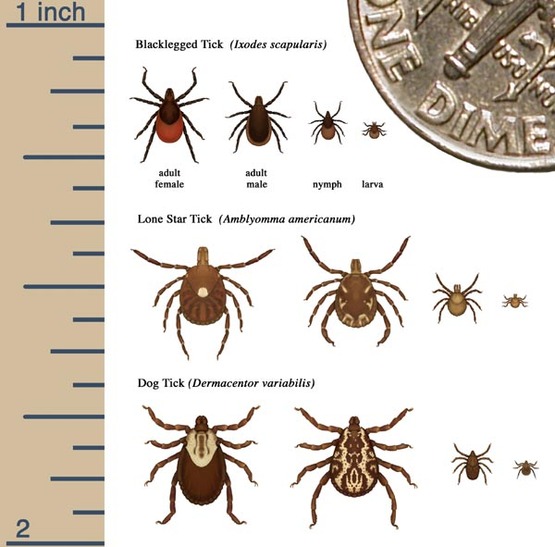
Ticks (and associated tick-born illnesses) have become an unfortunate staple in most natural landscapes across New York and the chances of encountering them are very likely.
Preventing tick bites - consider using insect repellents and clothing treatments to help reduce your risk of getting bitten and always complete a post hike tick check.
When using any chemical, be sure to review the manufacturer’s safety data sheet (SDS) and explicitly follow the instructions for use. For additional information view the Cornell Cooperative Extension Pesticide Safety Education Program (PSEP) webpage.
If you are bitten, read the CDC’s tick page on how to remove a tick, what to do with it once you have removed it, signs and symptoms to monitor for if bitten, and guidance on seeing a medical professional.
Here are some additional resources on tick prevention:
Tried and true - Insect Repellent | Sawyer Products
New and innovative - ElimiTick by Gamehide
Insect Shield | Insect Repellent Clothing | Built-in Bug Protection
Local Retailers (store name: address) of footwear, outerwear, and/or gear to get started
Panosian’s: 303 N Main St, Elmira, NY 14901
Hesselson’s: 163 E 14th St #1388, Elmira Heights, NY 14903
Boot Barn: 821 County Rd 64 Suite 3, Elmira, NY 14903
Shoe Dept: Arnot Mall, 3300 Chambers Rd Suite 5073, Horseheads, NY 14845
Famous Footwear: 845 County Rd 64, Elmira, NY 14903
Sportsman’s Warehouse: 830 County Rd 64 Unit 17, Elmira, NY 14903
Dick’s Sporting Goods: 1216 County Route 64, Horseheads, NY 14845
Kohl’s: 1200 County Rd 64, Horseheads, NY 14845
Tractor Supply Co.: 1020 Center St, Horseheads, NY 14845
Local Thrift and Reuse Centers often have some great equipment and outerwear as well
Salvation Army: 2502 Corning Rd, Elmira, NY 14903
Gifted Goods: 3312 S Main St, Horseheads, NY 14845
What if I encounter a snake or other wildlife?
According to the DEC, there are 17 snake species that may be encountered in New York, 3 of which are venomous (Eastern Massasauga, Timber Rattlesnake, and Northern Copperhead).
Snakes are protected in NY and are a valuable resource - helping to balance small mammal populations [that often carry Lyme disease].
While venomous snake encounters are rare in NY, Chemung County is home to one of the larger populations of timber rattlesnakes. If you encounter a snake anywhere, identify whether it is venomous from a distance and/or avoid the snake altogether.
3 characteristics of venomous snakes in NY include; an elliptical pupil (vs. round pupil), a pit (or opening) between the eye and the nostril, and undivided scales on the underside of the tail.
For more information on these super cool critters, visit these reference links:
Amphibians and Reptiles - NYSDEC
-
For wildlife encounters, in general, it is best to look with your eyes and not your hands. Often times handling wildlife can have consequences for you or the animal - in most cases, it is best to leave nature as it is and appreciate it from a distance.
For other tips on what to do if you encounter wildlife, check out this DEC page: "If you care, leave it there"
Places to Hike in and Around Chemung County
Cornell:
Public Use | Arnot Teaching and Research Forest
State Parks:
Two Rivers State Park Recreation Area - NYS Parks, Recreation & Historic Preservation
Newtown Battlefield State Park - NYS Parks, Recreation & Historic Preservation
Mark Twain State Park and Soaring Eagles Golf Course - NYS Parks, Recreation & Historic Preservation
State Forests:
Maple Hill State Forest - NYSDEC
County Parks:
Park Station | Chemung County, NY
Finger Lakes Land Trust:
Steege Hill Nature Preserve – Go Finger Lakes
Other Public Space Information:
Home - Tanglewood Nature Center
Chemung Valley Audubon Society | Mark Twain State Park
Chemung Valley Audubon Society | Gleason Audubon Sanctuary
Chemung Valley Audubon Society | Northrup Hill Audubon Wildlife Sanctuary
Chemung Valley Audubon Society | Spencer Crest Nature Center
Spencer Crest Nature and Research Center
Chemung Valley Audubon Society | Other Sites
Hike Preparedness
"Hope for the best and plan for the worst" is a commonly spoken phrase among outdoor recreation enthusiasts.
Below are some resources to help you in the off chance your outdoor experience doesn't go according to plan:
Location sharing with family and friends is a good habit to get into before setting off on a hike. Apps like Life360 or other location sharing is a good idea, especially if you plan on going alone.
What3words is an app that has coded every 3 square meters on the globe with 3 unique words to simplify location sharing.
Most phones have an SOS or emergency calling feature that can call or share location with emergency services, without having to unlock the device.
Keep in mind, many app and cell phone functions require service to transmit locations, and there are many local areas that do not get reliable cell service.
There is no substitute for sharing your plan.
Make sure you have a plan (at least, where you are going and when you plan to be back) ahead of hikes or other outdoor recreation and share/confirm those plans with reliable friends or relatives before heading out.
Other Relative Programs: